
Cautious Concealing
Activation
Positivity
Population
Needs
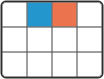

The Cautious Concealing state is characterized by a strong need for more Success—to feel competent, valued, and able to prove one’s worth—alongside a strong need for less Scorn—to avoid shame, criticism, or the sting of feeling judged and diminished.
This is not a trait, but an emotional state anyone can experience when their efforts feel exposed to ridicule or undervalued. It arises when someone wants deeply to succeed, but fears that putting themselves out there will backfire—that trying and failing will bring not just disappointment, but derision.
The result is a defensive posture: holding back, hiding potential, and keeping thoughts or abilities under wraps. The motivation to do well is still alive—but it’s being muffled by a fear of being shamed, dismissed, or seen as “not enough.” The internal voice says: Don’t take the risk. Don’t give them the chance to laugh. Keep your guard up.
In teams, classrooms, or social groups, this state can look like disengagement, but it’s actually the opposite: it reflects a quiet vigilance, a testing of the waters, a scan for emotional safety. There’s often a desire to contribute, to be recognized—but only if it feels safe from mockery, misunderstanding, or invalidation.
This state is best supported by environments that reduce emotional risk and increase opportunities for earned confidence. That means creating space where effort is acknowledged without being publicly evaluated, where people can demonstrate capability without fear of ridicule, and where dignity is preserved even in moments of imperfection.
When the threat of scorn recedes and success feels attainable, the cautious guard can lower. The desire to contribute, connect, and excel re-emerges—not as performance, but as a natural extension of restored emotional safety and self-worth.
How to Approach & Probing Questions
Interestingly, this is a need state encountered regularly when doing demonstrations of AgileBrain® for senior executives, particularly those in tenuous positions. In truth, by not responding, they are actually telling us quite a lot about their current state. Interestingly, because of their reticence to reveal themselves through an online assessment, they are particularly good prospects for a private, personal relationship. Once trust is established, and they are assured of confidentiality, those in a Cautious Concealing mode should be encouraged to re-take the AgileBrain® exercise, when they are ready to share a deeper layer of themselves.