
The Exercise begins with a Prompt
“When I think about ___________,
I wish I could feel a little more/less…”
The AgileBrain exercise provides a priming sentence stem or prompt (e.g., “When I think about my work, I wish I could feel a little more (for positive images) / less (for negative images)…) and asks the participant to complete the sentence by selecting images that match that feeling.
AgileBrain exposes the images for very short periods – just enough time to respond emotionally, not rationally. The specific images that are selected and the speed of those selections are captured, allowing AgileBrain to measure the intensity of need the participant feels in each specific need area or cell.
Results: Intensity of the Need
Images selected and speed of selection measure the intensity of need felt in that need area…
When the results are calculated, each need cell is color-coded to reflect the intensity of emotional response: darker shade indicates stronger emotional response in that area; lighter shade indicates less emotional responses in that area. A dark shade can be said to indicate an “activated” emotional need. A pale shade can be said to indicate a “settled” emotional need.
Sample Profile
Self
Material
Social
Spiritual
Aspirational
Potential

Success
Recognition
Purpose

Experiential
Authenticity

Immersion
Caring
Ethics
Foundational
Safety
Autonomy
Inclusion
Justice
Results: Promotion (want more) vs Prevention (want less) Pie Chart

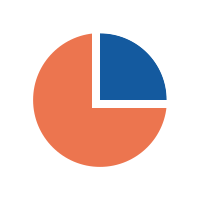
A pie chart is generated, displaying the mix of positive (hopes), and negative (fears), response in an emotional need area.
Every emotional need is a two-sided coin: It can represent strivings for more positive feelings (e.g., wanting to feel successful) or a desire for relief from negative feelings (e.g., wanting not to feel like a failure).
For the strongest emotional responses only, a color-coded pie chart is also shown. It illustrates the relative contributions of positive (blue) and negative (orange) emotional needs: larger blue slices indicate that positive needs contributed more than negative ones; larger orange slices indicate more negative needs than positives. Equal-sized blue and orange slices indicate the positive and negative needs contributed equally.
Sample Profile
Self
Material
Social
Spiritual
Aspirational
Potential
Success
Recognition
Purpose
Experiential
Authenticity
Immersion
Caring
Ethics
Foundational
Safety
Autonomy
Inclusion
Justice
Results: Feedback #1 –- Putting Words to Your Emotions
The first set of feedback is intended to help participants understand and articulate their emotional response. This feedback appears on the report’s second page and provides a paragraph for each of the strongest emotional responses. It is helpful to read these paragraphs carefully and reflectively. Do the words resonate? Are they consistent with your sense of the situation?
Note: You may want to refer to the Exploring Emotional Needs in Depth for more insight on the emotions, including definitions, mantras and common words to help facilitate understanding.
Note: Emotional areas that do not show activation are generally considered “quiet” or “settled” at the time of assessment and, therefore, do not receive feedback here.
It is important to remember, however, that “settled” emotional needs are important and worthy of discussion. All twelve needs are universal and exist in every adult, although the saliency of each need varies among people and within the same person over time. They may represent areas of strength and validation to be explored. They may also represent stable bases to build on in a developmental / coaching context.
Results: Tailored Feedback #2 – Putting Your Emotions to Work
The second set of feedback is intended to help participants reflect on the findings and find a pathway forward. This feedback generally appears on the report’s third page (although it may appear later if there are many strong emotional responses) and provides a paragraph providing context and suggested steps to process the strongest emotional responses.
It is helpful to read these paragraphs a few times and jot down notes.
- Do patterns of behavior or feelings emerge?
- Are their identifiable roadblocks (people, situations, emotions) that require deeper reflection and possibly intervention?
- What one thing would make a difference today?
Come back to the results several times over a week or so to push thinking and explore possible solutions to address emotional roadblocks and leverage emotional strengths.