Using AgileBrain for Decision Making & Problem Solving
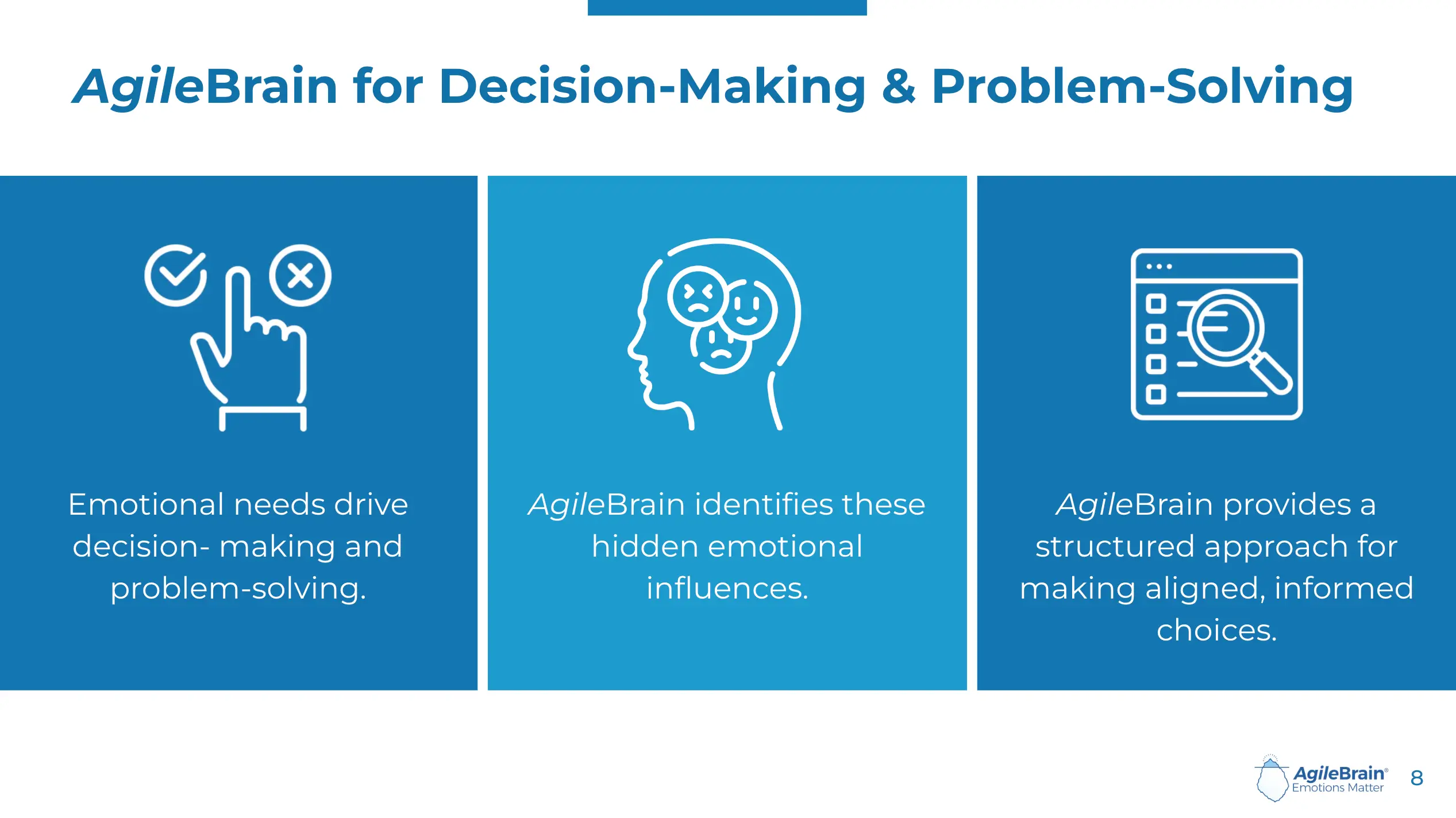
By integrating emotional intelligence and neuroscience into decision-making, AgileBrain helps individuals recognize the emotional needs driving their choices and improve problem-solving outcomes.


HOST: Welcome to the discussion, everyone. Today we’re diving into the fascinating world of AgileBrain, and um, how it helps people make better decisions. It seems like we’re always battling our emotions when making choices, right?
GUEST: Absolutely. Yeah, we often think we’re being rational, but, um, our emotional needs are secretly pulling the strings, you know?
HOST: I see. So, how does AgileBrain help us untangle this, uh, emotional knot?
GUEST: Well, it helps us identify those hidden needs and, um, use that awareness to make more conscious choices.
HOST: Sounds intriguing. Let’s explore the AgileBrain framework. Can you explain the three levels of emotional needs within the AgileBrain framework?
GUEST: Sure. There’s the Foundational level, focusing on basic needs like safety and autonomy. And then there’s the Experiential level, dealing with daily emotional engagement, things like authenticity and caring. Finally, the Aspirational level covers higher needs like purpose and recognition.
HOST: Right. So, it’s like a hierarchy of needs for our emotions?
GUEST: Exactly. Understanding which level is driving our decisions is, um, key.
HOST: Okay. And how does this understanding translate into better decision-making?
GUEST: It allows us to move beyond reacting emotionally and, instead, make choices aligned with our overall well-being and goals.
HOST: Let’s talk about the four-step process for applying AgileBrain. What’s the first step?
GUEST: The first step is identifying the emotional activation behind the issue. We need to pinpoint which emotional needs are driving our reactions.
HOST: So, self-reflection is crucial here?
GUEST: Absolutely. Asking ourselves questions about our feelings and connecting them to the three levels of needs.
HOST: Got it. And step two?
GUEST: Step two is reframing the problem with emotional awareness. We shift from seeing the problem as purely external to understanding the underlying emotional component.
HOST: So, it’s about digging deeper than the surface level?
GUEST: Precisely. Recognizing that the challenge might be less about the situation itself and more about our unmet emotional needs.
HOST: Okay. What about steps three and four?
GUEST: Step three is aligning solutions with both emotional and logical needs. We need solutions that address both the practical aspects and the emotional root cause. And step four is tracking emotional activation over time. It’s about continuous self-assessment and adjustment.
HOST: Can you give us an example of how this process has worked with a client?
GUEST: Sure. I worked with a client struggling with career indecision. They felt overwhelmed and stressed, which pointed to unmet Foundational needs, specifically safety and autonomy.
HOST: So, they were afraid of change?
GUEST: Exactly. By reframing the problem, we realized their fear stemmed from a lack of control and security.
HOST: I see. And how did you help them?
GUEST: We developed a plan that addressed both their emotional needs and their career goals. This included exploring options that offered more control and security, while also aligning with their aspirations.
HOST: Right. And what was the outcome?
GUEST: They made a career change that felt empowering and aligned with their values, leading to increased job satisfaction and reduced stress.
HOST: How does AgileBrain help address cognitive biases in decision-making?
GUEST: By bringing awareness to our emotional drivers, we can recognize and mitigate the influence of biases. For example, if we’re making a hiring decision, we can be more objective by acknowledging any emotional preferences.
HOST: So, it’s about being mindful of our emotional responses?
GUEST: Precisely. It’s about recognizing that our emotions can cloud our judgment and actively working to counteract those biases.
HOST: That’s a powerful tool. How does the AgileBrain approach differ from traditional decision-making models like Expected Utility Theory?
GUEST: Traditional models often ignore the emotional aspect. AgileBrain integrates emotional intelligence, providing a more holistic and realistic approach.
HOST: So, it’s a more human-centered approach?
GUEST: Exactly. It acknowledges that we’re not always rational beings and that our emotions play a significant role in our choices.
HOST: It seems like a more effective way to navigate complex decisions. Can AgileBrain be applied in various contexts, like work, relationships, or personal goals?
GUEST: Absolutely. The framework is adaptable to any situation where emotional needs influence decision-making. Whether it’s a workplace conflict or a personal dilemma, the principles remain the same.
HOST: So, it’s a versatile tool for self-improvement?
GUEST: Precisely. It’s about developing emotional awareness and using that awareness to make more informed and fulfilling choices.
HOST: That’s very insightful. What are some common challenges people face when trying to apply AgileBrain?
GUEST: One challenge is the initial self-reflection. It can be difficult to honestly assess our own emotions and motivations.
HOST: So, it requires self-awareness?
GUEST: Absolutely. And it takes practice. Another challenge is balancing emotional needs with practical considerations. We can’t always prioritize emotions over logic.
HOST: It’s about finding a balance?
GUEST: Exactly. It’s about integrating both aspects for a more effective approach.
HOST: That was a great discussion! Thank you for sharing your expertise on AgileBrain and its application in decision-making and problem-solving. It’s clear that understanding our emotional needs is key to making better choices.
GUEST: My pleasure. I hope this discussion helps listeners gain a better understanding of how AgileBrain can empower them to make more conscious and fulfilling decisions.
HOST: Absolutely. Thank you again.
Training Module Sample